

“AI is all hype!”
“AI will transform everything!”
The truth, as history shows, is more complicated. When you examine the predictable patterns of disruptive technologies, you will find that both perspectives are often true at the same time. To illustrate this point, let’s explore the infamous dot-com bubble of the late 90s.
Lessons From the Past
To analyze the internet boom, we will use Cisco Systems as a proxy for the broader tech market because it was a backbone of the early internet.

At first glance, Cisco’s stock chart looks like the classic boom-and-bust story. But if you look closely, the inflection points tell a much richer story. As we explore these different phases, you may find the patterns eerily similar to the current AI cycle.
1) The Novelty Phase
If you asked someone in the early 90s what the internet was, the answer probably would’ve been something like chat rooms. A few years later, the common answers shifted to downloading music illegally. But would anyone describe the internet that way today? Not even close.
This is the novelty phase. Early adopters are excited by the technology and its potential, but many of them are out of touch with the general population who do not understand the technology and do not yet see it affecting their lives.
As an out-of-touch early adopter myself, I can still remember trying to convince my parents that it was safe to provide their credit card number to an obscure internet bookseller called Amazon. But the lightbulb was beginning to turn on. Little did we know, we were at the cusp of the most rapid phase of technology development.
2) The Hype Phase
Then the perfect storm hit.
People finally started to get it. Nothing seemed impossible. Exciting websites like eBay and Ask Jeeves seemed to be popping up daily. Everyone looked forward to hearing a friendly voice declaring “you’ve got mail!” Whatever the future might hold, most agreed it would be huge.
It also took on a Wild West feel. Search engines battled for dominance. Hackers and scammers appeared, followed quickly by a new industry to stop them. Schools panicked about students “cheating” with online sources. And of course there was Y2K, Napster, and a sense that the internet was becoming uncontrollable.
And then came the famously bad ideas.
Pets.com. Webvan. Flooz. If you had “.com” in your name and a pitch deck, that alone could raise millions. The prevailing wisdom was “If you build it, they will come.” Except they didn’t, and the math was never going to work.
3) The Crash
Eventually the market tightened, interest rates rose, earnings disappointed, and the illusion cracked. The NASDAQ fell nearly 80%, wiping out trillions of dollars in value. Startups disappeared overnight. I cycled through half a dozen email addresses as services shut down.
I personally couldn’t help but feel a sense of loss. This promising future I envisioned was too good to be true. For many, this is where the story ends. Just another cautionary tale of boom-and-bust cycles for business schools to study.
But this isn’t where the story ends. There was one more phase, and it was the most important one of all.
4) The New Paradigm
What the Cisco chart doesn’t show is that, adjusted for splits, the stock price has nearly recovered since the hype peak. Yes, there was snake oil. Yes, most companies failed. But the ones that got it right (e.g., Amazon, Google, eBay, PayPal) became world-defining giants. And many more giants rose from the ashes.
The dot-com crash didn’t kill the internet. It cleared the field and gave birth to the modern tech industry.
Today nearly every customer-facing business has:
- A website
- Digital marketing campaigns
- SEO strategies
- Cloud infrastructure
Entire industries are dedicated to each of these and more.
Was the internet hyped? Absolutely.
Did it change everything? Absolutely.
The AI era
Now let’s overlay Nvidia on the same chart. In case you are not familiar, Nvidia builds graphics cards that are very important for training AI models. As an enablement company, it is essentially the Cisco of the AI era.
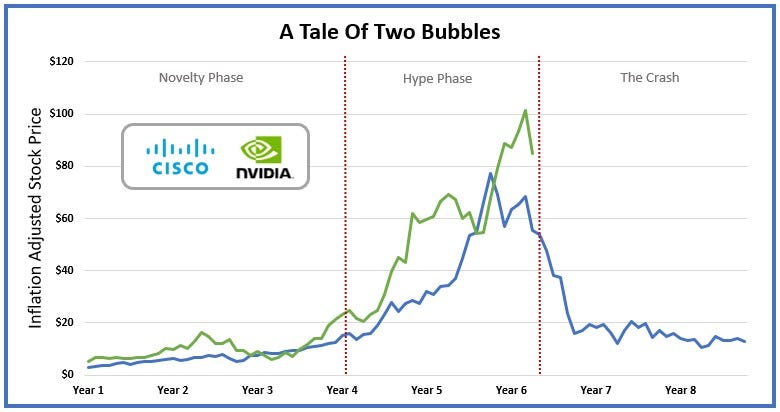
Before I overlayed them, I suspected that the patterns might line up loosely. But the resemblance was far more than I anticipated. It was too similar. Not this again!
Let’s walk through the AI cycle so far to see if it still matches up.
1) The Novelty Phase
Notice the AI novelty phase started with chatbots, much like the internet starting with chat rooms. At least people are not downloading illegal content, right? No, they are creating it this time.
Some patterns repeat themselves almost perfectly.
2) The Hype Phase
Today, we are squarely in the hype phase. Amazing AI ideas pop up daily. Entire industries are shifting.
And yet the Wild West feeling is unmistakable:
- People launching AI products without knowing what’s legal.
- Deepfakes and new scams emerging, with industries springing up to counter them.
- Schools panicking about AI cheating.
- People worrying the world will end.
Déjà vu.
Bubble or not, Big Tech is also all-in on AI. They remember how the internet cycle reshaped the world. They don’t want the next startup to replace them.
But again, there is a lot of snake oil:
- AI lipstick slapped onto old products
- “.ai” domains replacing the “.com” mania
- Overnight AI experts everywhere
And sadly, many businesses have already been burned by poor implementations and now believe “AI is hype.” I can’t count how many times I have had to explain:
“If you needed brain surgery, you would go to an experienced neurologist. You can’t expect good results for someone creating intelligence after a short bootcamp.”
Or:
“AI can be trained with a single line of code or built as a fully customized solution. Both are sold as ‘AI,’ but only one will positively impact your business.”
I apologize for the rant. It just gets to me.
3) The Crash
At some point there will be a correction. But please note, this is not stock advice. Even if the pattern holds true, it’s rarely the same. Don’t go shorting Nvidia stock just yet.
But market cycles do rhyme. At some point the market will tighten and many AI startups will vanish. I have watched this firsthand as I have exhibited at business conferences.
Three years ago, four out of about two hundred booths were AI companies. The next year at the same conference, half of them were AI companies (mostly ChatGPT wrappers). This year, maybe fifteen remained.
Businesses know they need AI, but they are afraid of missteps and are waiting for the path to be clear. Waiting can feel safe.
But it’s also a risk.
4) The New Paradigm
“Whatever you do, just start. You don’t want to observe an exponential trend because in a couple of years you will be so far behind it’s incredible.”
— Jensen Huang, Nvidia CEO
I know he is a little biased, but he also has a point.
AI systems compound over time. The companies that begin iterating, learning, and adapting now will end up far ahead when the dust settles. After the dot-com collapse, many businesses that sat on the sidelines lost market share or disappeared entirely. The ones who leaned in became the market leaders.
And even now, we are already seeing massive shifts:
- New fields are forming around AI security
- Vector and graph database expertise is becoming essential
- New roles centered around AI experience management
- And perhaps the most transformative shift of this era: the rise of the AI-enabled solopreneur (stay tuned for an article on this)
Conclusion
So yes, AI is absolutely hyped. But it isn’t going away and it will change everything.
The internet didn’t end with chat rooms. AI will not end with chatbots.
Disruptive technologies like this do not come around often.
The question isn’t whether AI will reshape the world.
It’s whether you will reshape the world with AI.
About me
With over a decade of experience in Applied AI Science and as the founder of Model Forge AI, I specialize in tailored machine learning architectures, decision-support models, and grounded LLM integrations. You can find me here:


